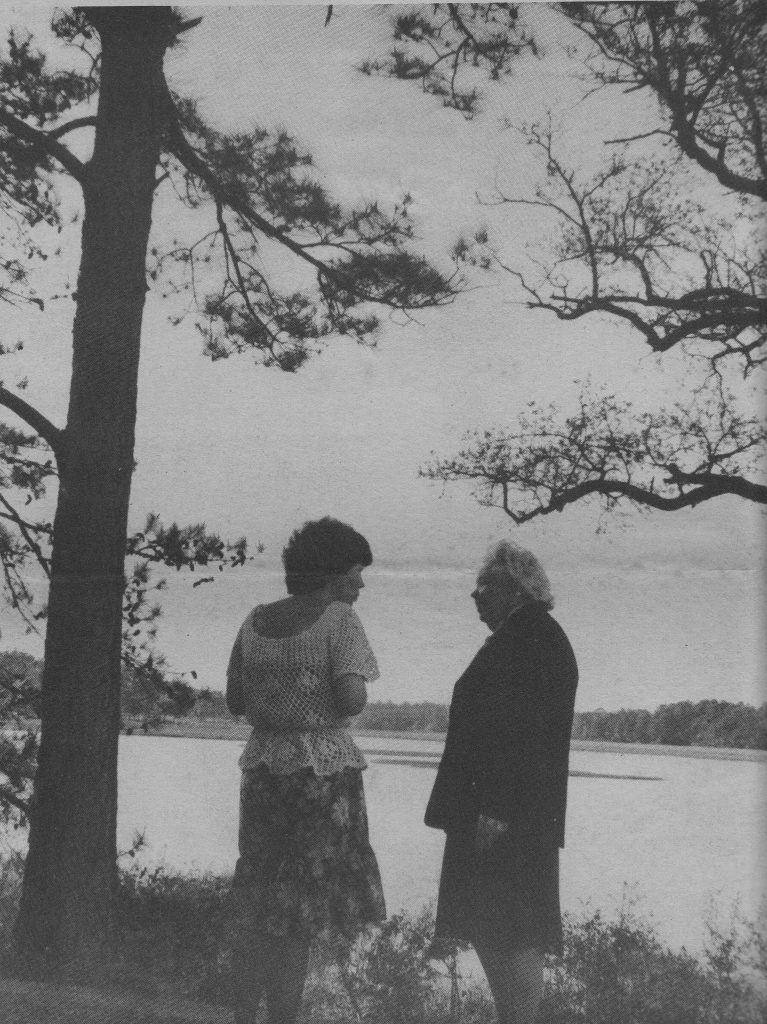
Cape Faire: Tell us, if you would , how you got started on your first book, Between the Creeks.
Hewlett: It didn’t begin as a book, it was just going to be a short paper. I didn’t even know where to look for things. I had to find where the material was, so I began to interview people, went to the public library—the most fun for me was discovering a new source. Of course, other people probably knew those sources were there all the time but it was a discovery for me. Then I found old records in the courthouse. I looked there first because I knew there was an old plantation down here called Masonboro and I wanted to find out how the name got started. It was around the Parsley place, but the name came to be applied to the whole area after awhile. The plantation was started sometime before 1754 but I really couldn’t find the beginning of it.
There was an old Masonic lodge down here, too, that was even earlier than Masonboro Plantation so the name may have come from that and then perhaps taken over by the plantation.
Cape Faire: Wonder why the Masons would have come way out here in the country to build their lodge?
Hewlett: Well, they seemed to have done it that way in a lot of instances. They started out as a military club of sorts. They would go way out from the towns and start their little places to go for week-ends, parties and things like that and to have their meetings. This was just the right distance from Wilmington and they had a place on the water too.
A lot of people would go upstate to the mountains in the summer or even to Pittsboro, but a lot of other folks had summer homes around Masonboro. They’d have their permanent homes in Brunswick Town; in fact, I think the name of Masonboro got started from the people of Brunswick Town, who were mostly Masons, wanting a little area down here for a summer village which they called Masonborough. I’m sure the Masonic connection was involved with the naming of the area somehow.
Cape Faire: Well, what took you past the formative paper-stage of this book?
Hewlett: Well, I just have always loved this area ever since I moved down here and I just wanted to know more about it; where the people came from and so forth. So it just got bigger and bigger and bigger. I had no idea it woudl get to be a book, and even if it was, I had no idea it would ever get published! So it was a surprise to me all the way through.
Cape Faire: Who first suggested that you try to publish it? Was it your husband?
Hewlett: No, I felt that after I had dug up all this material, it would be a shame to let it get lost again.
Cape Faire: Well, I certainly appreciate it. You’ve got my roots, you did the work, and then you gave me the book!
Hewlett: And I felt that I had to save it some way or another. But you said something to me the other day about my being a historian: I am not a historian by any means. The only historical research I’ve ever done was to get the facts for this book and the art book. And I’m not a historian.
Cape Faire: O.K. We’ll call you a Chronicler, but I think your readers will disagree with you. I can vouch for the quality of your documentation. Both of your books are thoroughly foot-noted and certainly any historian using your book for research would be thrilled to find your sources so well documented!
Hewlett: Well, that’s better, I’m not a historian because my subjects are limited. Would you like to know how the book got started?
Cape Faire: Great! Thanks, I forgot you’re a seasoned interviewer. You can tell me how to do this!
Hewlett: Claude Howell, who I’ve known most of my life, said to me at a party one night, “I wish you would come out to the college and see the art archives that I’ve been trying to get together out there.” He said, “Somebody ought to write a history of the art development in this area.” So I didn’t think too much about it until I saw him again and he mentioned it again. So I went out there. He had shelf after shelf of looseleaf notebooks filled with newspaper clippings and things he had saved all of his life and put together in there. Clippings from all over the state. I thought, well, he’s caught me right after finishing the other book and you develop certain habits, you know, after you’ve done something that you feel like you can’t stop now. So I was just right to be caught to do something else. And of course my mother and sisters being interested in art, I had more personal knowledge in the arts than in history of the area.
Cape Faire: Claude is a cagey rascal. He knew he had you from the beginning I bet!
Hewlett: Yes, and he really wanted it to get done. So I said, well, I’ll try, and if it comes out fine we’ll do something with it. If it doesn’t, we’ll try to make it right, and if it’s still not right we can forget it. So I went into it. Of course, sifting out the New Hanover County stuff from all that massive amount of state material was a big job, but I like digging things out. I’ve always liked to do that.
Cape Faire: How long did you work on the art book?
Hewlett: Both of them took about two years each. It took longer than that to wind them up and get them printed but the actual research and writing took about two years each.
Cape Faire: How have your books been received?
Hewlett: Well, I haven’t had much chance to judge on the new one but Between the Creeks has been selling a few copies right along. What really sold it was a thing I hadn’t even planned to do and that was all the family trees in the back. I hadn’t planned to put that in, but when I saw that 8 or 10 families that lived down here had all married and intermarried so many times that if it wasn’t straightened out in this generation, it would never be straightened out. And it was very difficult to do even now.
Cape Faire: Did you talk to old man Melton? He was the only man I knew as a child who didn’t have indoor plumbing. He was still alive in 1970, wasn’t he?
Hewlett: No, he was gone, but I talked to all the old people and then I began to sweat them out for fear they’d be dead and gone before the book was finished. And some of them were. I lost some of them and I felt terrible that they didn’t get to see it.
Cape Faire: We can understand the feeling, but you’ve done our community a tremendous service: besides it’s the only book I’ve ever been in!
—about this time Ted Hewlett, Jr., the 7th generation of Hewletts to live on Masonboro Sound and Hewlett’s Creek, comes in from flying his kite with grandpa Hewlett whom we passed out in the fields on the way in for the interview. He is a bit nervous about our tape recorder—he’s worried about it stealing his voice but we promise to give it back. The conversation is drifting but there are so many more things to talk about.—
Hewlett: Well, the biggest job of all was researching all the titles of the property down here. I searched every title on Masonboro Sound between the creeks and took them back to the King’s land-grant and up to the present day (1970). Then I drew to scale each plot of ground and put them together from the descriptions. I just took a floor about half the size of this (living) room and took the property and put it together to see if it would come out. And it came out! There was Masonboro Sound and I had done it like a patchwork quilt.
Cape Faire: That’s a salute to our property lawyers in a sense!
Hewlett: Yes, I had to find out how many feet there were in a pole and all those things!
Cape Faire: These descriptions which you worked from were metes and bounds description, right? From the big oak over two rods to such and such creek…
Hewlett: …to a dead pine stump and all of that. And some of the early monuments were imaginary because in some of the early descriptions they would survey around the water’s edge and refer back to something imaginary like a red maple back in the woods.
Cape Faire: In other words the monument was no longer there in some cases?
Hewlett: Well, no, it wasn’t even there to begin with. The surveyors didn’t even go back in the woods to see if there was a red maple like they were describing!
Cape Faire: How did Addison acquire his property here?
Hewlett: At one time, old John [Captain Jack] Hewlett, Addison’s great-grandfather, owned the entire south bank of Hewlett’s Creek and some property down on the sound-front further around. He went on around the mouth of the creek and then skipped several plots and had two more plots down there (on the waterway). And he began way up here at Masonboro Baptist Church and came on around down the south bank that way. That’s when it came to be called Hewlett’s Creek. His home was on the church property or right next to it because the Andersons who had the sound-front place there owned clear back to the church. They deeded the back end of their property to the church and that’s how the church got its propertyl And that was right next door to John Hewlett’s and the church had started in his home so they just built right next to his house.
The interesting part of what I have done is being able to see Masonboro, not just as it is today or just like it used to be years ago, but sort of a telescoped blending of time. The whole thing….and when I see a piece of property now, I get so much pleasure out of being able to see it as an ongoing process.
Cape Faire: Have you got any other projects in the works?
Hewlett: No, I finished the book on attorneys which I may have mentioned to you.
Cape Faire: No! You hadn’t told us you had another book already done.
Hewlett: It’s really an outline form of each lawyer who had ever practiced in New Hanover County. It is not published, we simply had 40 or 50 printed for orders we had before we did it. This was fro research I had collected too. Here let me show you; some of them are very old. Here’s one, Samuel Ashe, for instance, was born in 1725 and you can see I’ve just done an outline by dates of their activities. We had over 500 lawyers, with the earliest dating from 1724.
Cape Faire: What was the name of that law school downtown where a lot of our early lawyers were trained?
Hewlett: Wilmington Law School. H. Edmund Rogers was the teacher. He had it from 1913 to 1941 when the war came on. But that was not the first one. When I got to researching we found another law school in 1872. It was held in the courthouse and operated by Judge Cantwell.
Cape Faire: How did these schools work?
Hewlett: Well, they had classes in the Superior Courtroom. This is the early one I’m talking about, the Cantwell School. They had a mock trial where the lawyers would take parts. But Rogers’ school, he had it in his law office. He would sit down with books and teach what he had to teach. He would just have maybe 3 or 4 students at a time.
Cape Faire: You said the Cantwell School was in the Superior Courtroom, what building would that have been? Is it standing now?
Hewlett: No, the courtroom we have now is about the 4th one we’ve had in Wilmington. They had two around Front and Market Streets—one way back in 1700 or so and it got delapidated, so they built one exactly like it in the same spot. This second courthouse was dedicated in 1799. One of the lawyers, we don’t know which one, wrote a poem regretting the tearing down of the old courthouse and it was the cleverest thing you’ve ever read. I’ve got it in the book there and the original is in the museum at 7th and Market. Then there was another courthouse on Princess Street between 2nd & 3rd and then the one we have now.
Cape Faire: We would like to continue this conversation for the rest of the day, but I think we’ve taken enough of your writing time; we don’t believe you have nothing you’re working on at the moment. But there’s one thing you could straighten us out about before we close. What are all the names you have discovered given to Wilmington through the years?
Hewlett: Wilmington was called New Liverpool at one time, also Newton and finally Wilmington. They tell me if you go in the Register of Deeds in Liverpool, England that you’ll think you’re in Wilmington, N.C. because they have so many of the same names, streets, people and so on.
Annie Crockette Williams (1910-1990) is the daughter of James C. and Etta Frizelle Williams. She married Addison Hewlett, Jr. in 1939, attended Duke University, and led a fascinating life. Crockette’s mother, Etta F. Williams, was the first president of the Wilmington Art Association. Her sister, Ethel Barret Williams Barrett, was the first director of the Wilmington Museum of Art. Her sister, Margaret Williams Davis, is one of Wilmington’s finest visual artists. My interview with her appeared in an arts journal Margie Talley and I created, Cape Faire Presse, in 1977.
Her books are
Between the Creeks: A History of Masonboro Sound, 1735-1970. Wilmington Printing Company (1971) Wilmington, N.C.
Two Centuries of Art In New Hanover County with a Foreword by Claude Howell. Moore Publishing Company (1976) Durham, N.C.
Between the Creeks, Revised: Masonboro Sound, 1735-1985. New Hanover Printing & Publishing Company (1985) Wilmington, N.C. with co-author, Mona Smalley
Attorneys of New Hanover County, 1724-1978
United States Judges of North Carolina