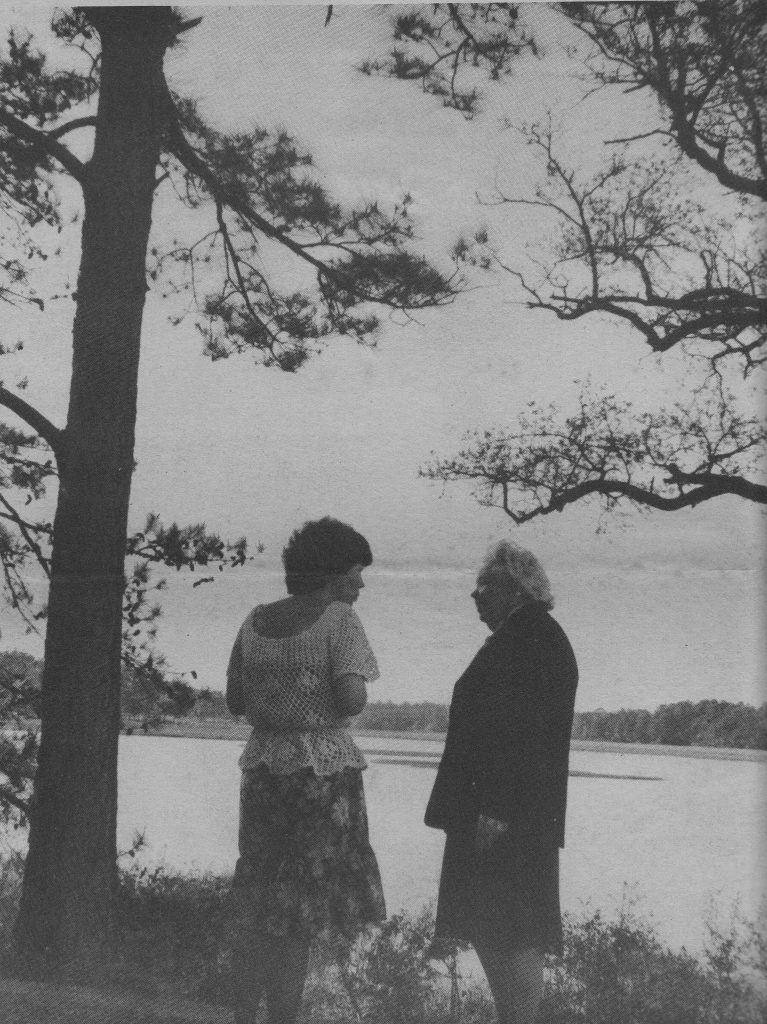
It seems fitting to begin this excursion into history with that of the Masonboro Baptist Church where my mother, a set of grandparents, great-grandparents, great-great grandparents, great-great-great grandparents and my great-great-great-great grandmother are buried.
History of the Masonboro Baptist Church
Crockette Hewlett, October 1, 1950
As one leaves the Wrightsville Beach Highway about three miles east of Wilmington, North Carolina, and turns right onto the Masonboro Loop Road, he soon sees the fields and interlocking woods of the community of Masonboro. Here and there appears a small white frame house under the spreading branches of a giant live-oak, and inside the scrubbed kitchen the housewife is busy with her baking or canning, while the young children run and play in the yard. In the fields nearby the farmer will be seen plowing with his mule or riding a well-used tractor. Here and there in the yards will be stretched fishing nets still damp from the waters of the Sound. And if one turns into one of the little oyster-shell roads which lead down to the water, he will see smoke rising from the chimney of some oyster-roast shed and catch a whiff of the delicious aroma rising from the roasting oysters.
The community of Masonboro is cupped between the arms of two creeks, Hewlett’s Creek on the north and Purviance (or Whiskey) Creek on the south, though it refuses to restrict itself just to this area and claims much of the populace beyond each of these boundaries. Masonboro Sound, threaded by the Inland Waterway, carries off the waters of these creeks and fills them up again with the flow of the tide. Faintly across the wide stretch of Sound and beyond a long thin line of sand dunes one can hear the roar of the tumbling surf. And over the whole quiet scene of green woods, productive fields and deep blue water settles a strange feeling of timelessness and a beautiful serenity, which may be prophetic of the eternal peace to come.
The community took its name from the fact that among the first settlers along the Sound-front was a group of Masons who held their lodge meetings on the upper floor of an old house known as the old Lewey house (which stood not far from the old Cassady house, later the Williams house, now occupied by the Crows). For many years the old Lewey house remained unoccucpied and was generally reputed to be haunted.
Masonboro, at one time written Masonborough, is rich in early American history. One of the signers of the Declaration of Independence, William Hooper, had a home here. So also did Major William Purviance, who was on General Washington’s staff. Thomas Godfrey, while living here, wrote the first drama of American literature, entitled: “The Price of Parthia”. He also wrote a poem, in about the year 1780, which begins:
“O come to Masonborough’s grove.
Ye Nymphs and Swains away,
Where blooming Innocence and Love
And Pleasure crown the day.”
As one travels southwardly along the Masonboro Loop Road, he will see just off to the right a small brick church set back among some trees; and if it is Sunday morning, the clear tones of the church bell will be heard far across the fields. This is our church—The Masonboro Baptist Church.
The church has been the focal point of the community for many years and has drawn unto it most of the people who live in the surrounding countryside. On Sundays the scattered neighbors gather for Sunday School and Church service, to sing heartily the old gospel hymns which our fathers loved. And when the benediction is given and the church members pour out of the building to stand about on the grass and under the shade of the old trees, we exchange with relish the little topics of interest among us which have accumulated during the week. It is our favorite method of visiting, and it is a long time before the last little group breaks up and the last automobile drives homeward.
I.
The history of our church goes back a long way. It would be impossible to give an accurate and complete account of it because of the few records which are available. Most of the church records were destroyed in the fire which consumed the home of J.R. Hollis on December 15, 1938.
The organization was founded in 1856, before the Civil War, and about a decade before there was any house of worship, though we find that as far back as 1848 and 1850 preaching services were held at a private residence by Rev. A.B. Alderman, a Baptist preacher, who, by the way, was the father of the Chairman of the Historical Society of the North Carolina State Convention, J.T. Alderman, of Henderson, NC.
During the early years of our country, Masonboro Sound was relatively inaccessible, since it was about seven miles from town and reached only by deep sandy roads which went around the heads of the creeks. As there was no church in the community, many of the residents attended the First Baptist Church in Wilmington and held their memberships there. It was one of these members, Captain John Hewlett, who became the founder of the Masonboro Church.
Feeling the need of a worship service for the people of his community, John Hewlett invited them to his home, which was located a little back of Mr. John Capps’ store, within sight of where the present church building stands. When a preacher could not be obtained, John Hewlett led the services himself. soon the people began to come in such numbers that there were not enough chairs to seat them. Some long boards were brought and placed on round wooden blocks, and these cared for the seating of the congregation. In cold or wet weather and at night the seats were erected inside the house, while day services were held under the trees in the yard.
Sometimes the services were conducted by missionaries who traveled about in those days preaching at first one place and then another. One of these itinerant missionaries was Mr. John B. Barlow, a cooper by trade, who made turpentine barrels. Often he would walk twenty-five or thirty miles to fill an appointment.
Other visiting ministers who preached in the Hewlett home were Rev. Reuben Grant (a Methodist minister); Rev. A.D. Betts (another Methodist minister, and Rev. Joe E. King (a regular Missionary Baptist).
Among the early members of the church, besides Captain and Mrs. John Hewlett, were Mrs. Ellen Curtis (better known to the children as Aunt Nellie), Comfort Johnson (an aunt of Miles C. Walton), Annie Wilson, Serena Hewlett, Rebekah Beasley, Catherine Farrow, Annie Walton (mother of Miles C. Walton), Mr. and Mrs. Elijah Hewlett, Mr. and Mrs. Jack Farrow, Mr. and Mrs. John J. Wagner (Mr. Wagner was the first church clerk), Mr. Charles Thorpe, Mr. Eliza Orrell, and Mr. and Mrs. Alonza Hewlett.
The influence of these good people has been a blessing to our community through the years. Many thrilling incidents in the life of Captain John Hewlett, better known in the neighborhood as Uncle Jackie, could be related. At the beginning of the War Between the States when there was a call for volunteers, many of the Masonboro boys responded to the call and fell into ranks. Uncle Jackie went and shook the hand of each of them and said, “Boys, I don’t know where you will be called upon to go, or how long you will be compelled to stay, but remember, wherever you are and however you fare, that I am praying for you that God will send you all back home again to assist me in building up the Kingdom of Christ in our neighborhood.” These brave fellows marched away and more than once faced the enemy’s fire. They were seen at such places as Chancellorsville, Gettysburg, in front at Petersburg, and that most terrific bombardment at Fort Fisher. Some of them were badly wounded, but all came back after the four years of struggle were over and assisted in doing the thing Uncle Jackie said he wished them to do—the thing that made possible the church building erected and dedicated by them to the service of God.
Another incident in the life of John Hewlett will be well remembered. Mrs. Annie Walton, mother of Miles C. Walton (who later became a pastor of this church), was stricken very ill, so ill that little hope could be held for her recovery. One day she asked her husband to send for Uncle Jackie that he might pray for her that some change might take place in her condition. The appearance of Uncle Jackie as he rode on his horse up into the yard is unforgettable. His black hair, which he wore long, was flowing out from beneath a high beaver hat, and he was wearing a long-tailed coat, like the old statesmen of the type of John Calhoun might have worn. He alighted from his horse and took the hand of each of the children and carried them into the house and had them all kneel in prayer with their sick mother, and Miles Walton said that while he knelt there at his mother’s bedside, he was just as certain that God would hear the prayer of this man and that his mother would soon be well again as he was sure he was kneeling there, so much faith had he in this man and what he said. In a few days, Mrs. Walton began to improve and soon was able to go to the home of Captain Hewlett, where the church was still holding its meetings, and there she united with the church and was afterwards baptized into its fellowship by Dr. Elwell.
It was about this time that a great spirit of revival began to be manifest in the group, and a more definite organization was affected and more members were added, some by baptism, others by letter, and still others by experience, until a strong sentiment prevailed in favor of building a House of Worship.
It was then that Dr. Edwin A. Anderson (father of the late Edwin A. Anderson of the U.S. Navy), who had a home on the Soundfront, gave them the land on which to build their church. It was the land on which the present church building stands, and the deed was made out to the trustees of the church: Elijah Hewlett, John G. Wagner, and John J. Beasley, and bears the date of February 11, 1869.
Earnestly the members set about drawing plans and gathering materials for the construction of the church. Persons who do not know of the hardships of those days of Reconstruction cannot appreciate the difficulties to be overcome in this undertaking, but these were hardy men returned home from the fields of battle, well-seasoned and anxious to make a better world. When they inquired about obtaining lumber at the mills, most of the mills agreed to donate their work if the church would be responsible for the hauling. So the young men went out into the nearby woods and cut down tall straight trees and hauled them to the mills in “carrylogs.” Everyone who could wield a hammer went to work on the church. Mr. Henry Risley, a local contractor, was in charge of building operations, and Mr. Frank Hewlett was a supervising carpenter.
Some records have it that the building was completed in the summer of 1867, though this was two years before the deed for the land was made out. Still there is no reason why this may not have been so. The building was made of white clapboards and faced on the road which ran by it on the south. It consisted of a large assembly hall with a pulpit and a vestibule.
It was many years later that the steeple was constructed to house a church bell bought with money provided for that purpose in a will left by Mrs. Catherine May, one of the church members. The bell was purchased and lay in the church yard for quite awhile before they could get the steeple built. Mr. A.G. Call constructed the steeple, and it was Mr. Alonza Hewlett who rang the bell on Sunday mornings.
II.
The first pastor to be called to the new church was Dr. John Elwell, a medical doctor and also a Baptist minister of great ability, who preached for them once a month. He soon resigned because of failing health, and for awhile the church was ably supplied by pastors of its own and other denominations, among them Rev. Joe E. King, Rev. Reuben Grant, John Paul Leonard, and A.A. Edwards. The church then called Rev. A. Paul Reperton, and a great revival followed. It was then that Mrs. Sarah Hollis Hewlett went forward on profession of faith, the first to do so in the new church building. She was followed by her husband, Alonza Hewlett, and also by Mrs. Kate Hewlett, Miss Maria Hewlett (later Mrs. Maria Hollis), and Miss Jane Johnson. These, along with others, were baptized in the creek the following March.
By this time the brethren up in the city began to take some notice of this thriving church, and among those who took a special interest in the work were George R. French, Alfred L. Alderman, Dr. Freeman, Joseph Taylor, and a young man known as John Hamilton.
It is not known how long the church was served by Rev. Reperton, but it must have been for only a short time, as old records show that in 1870 the church called Rev. John B. Barlow, one of the most consecrated and devout men ever known—the man whom Miles Walton liked to refer to as his father in the ministry. Under the ministry of this faithful leader, the church made repaid strides in its progress for the space of eight years. As many as forty persons were baptized on one occasion at Elijah Hewlett’s landing, the pastor being assisted by Rev. Joe E. King, who was then a Missionary Baptist. On this occasion it was estimated that a thousand people were present at the baptism.
Mention should be made of the faithful and untiring efforts of a young school-teacher who came during Brother Barlow’s ministry to teach in the community and who threw her young life into the work of the church, and who was of great help to many, including Miles Walton. This young lady was then Miss Mollie Holton, of High Point, N.C., later becoming Mrs. J.A. Montgomery, of Wilmington.
At the close of the faithful pastorate of Rev. Barlow, the church called Rev. W.M. Kennedy, a very brilliant man and a fine orator, who did splendid service, especially as a teacher of Baptist principles and New Testament doctrines. He lived in Warsaw, N.C., and came down to Masonboro once a month to preach. He served about three years and was succeeded by Rev. George Simon Best, who served about a year or more. The next was Rev. A.A. Edwards, and following him was Rev. John J. Beasley, the first one of three sons of this church that God laid His hand upon and led to the gospel ministry, the second being Miles C. Walton, and the third being that most beloved and amiable character Robert Hewlett, son of Elijah Hewlett. There was also another son of the church to enter the ministry. His name was James Mintz, but there seems to be no information available concerning him.
Beasley had served in the Civil War and was said to have a bullet in his abdomen.
Beasley was followed by Miles C. Walton, son of J.G. and Annie Walton, and father of Carey J. Walton. Mr. Miles was a thick-chested man, about five feet seven or eight, walking very erect, and having a heavy voice. It was said that he loved to eat fish, to tell funny stories, and he had a way of telling things that made one remember them. Though he did not have a great deal of education, he liked to study English, and was very careful about his use of grammar. Those of us who remember Mr. Miles think of him in his later years when he was Pastor Emeritus, how he sat in his rocking chair just to the right of the pulpit and said “amen” on the strong points of the preacher’s sermon.
During these early pastorates Sunday services were conducted once a month, always with a service on the Saturday night before. The church was able to secure some songbooks, which were without notes and printed in very small print, but Alonza Hewlett, who always sat on the end of the front bench, pitched the tune. When there was anyone to play the organ, he sat next to it. Mrs. Rosa Montford Hewlett was the first organist. Later on, Bettie Herring, a school-teacher who taught at the community school, often played the organ. One of the favorite songs was “In the Christian Home in Glory.”
The customs being what they were in those days, the church provided wooden boxes filled with sand for use as spittoons.
In 1880 Henry Croom became pastor, and he was followed by Daniel C. Kelly, and following him was a sweet-spirited young man from western North Carolina, S.D. Swain, who preached along about 18891. Then Miles Walton served as pastor a second time. From 1896 until the turn of the century William S. Ballard was pastor. He was followed by J.A. Smith, O.J. Peterson, G.A. Marton (who preached in the afternoons for about a year), J.W. Wheeler (a Methodist minister who became a Baptist—it was said that he never went anywhere without trading a horse), A.C. Chafin, E.J. Harrel, O.N. Marshall, James Clark (a powerful preacher who had just finished the seminary).
III.
With the coming of James Clark a field was formed with Winter Park Baptist Church, and continued until 1947 when Masonboro called its first full-time pastor.
Clark was followed by J.L. Shinn (who preached two or three years), and then by Bunyan Boney.
When war came in 1917, not a single man from Masonboro was drafted. The men from Masonboro who volunteered and served in World War I were:
Rob Hollis Harry E. Orrell
Roy Beasley Arthur Farrow
John Donnelly Rhodie Farrow
Johnny Kirkum Iley Farrow
Frank Hines
All returned after the war but Harry Orrell, who was killed in service.
Along about 1920 a B.Y.P.U. was organization at Masonboro. A group came down from the First Baptist Church in Wilmington and gave a program and helped them to organize. The B.Y.P.U. became a strong and popular group.
IV.
The next pastor was R.J. Hall. In 1926, while he was pastor, the church building was remodeled at a cost of $5,500, of which $2,500 was borrowed from a building and loan and $2,000 from the bank. The bank was paid back $100 a month, and the building and loan was paid by the Sunday School. The church house was turned about to face east, so that it look toward the newly-surfaced Masonboro Loop Road. Two wings were added to the main assembly room, and six Sunday School classrooms at the rear, causing the structure to take on the shape of a cross. The exterior was brick-veneered, and a fire-proof composition roof added.
Some of the members went before the Board of County Commissioners to ask for pipe to go under the road leading into the churchyard. Captain Dick Burnett came down to see about it, and before he got through he had paved a road from the highway up to the church.
Shortly after the remodeling work was done the church held a memorial service conducted by a former pastor, Rev. Miles C. Walton, at which time Mr. Miles gave a brief review of the history of the church as he knew it. This sermon was taken down in short-hand by Mrs. Margaret Herring McConnell and preserved for the church. The service was in memory of all the great Christian souls who had a part in the beginnings and furtherance of the work of the Masonboro Baptist Church, and Mr. Miles close his sermon very aptly with a quotation from Hebrews:
“Wherefore seeing we also are compassed about with
so great a cloud of witnesses, let us lay aside every
weight, and the sin which doth so easily beset us, and
let us run with patience the race that is set before us,
“Looking unto Jesus the author and finisher of our
faith; who, for the joy that was set before him,
endured the cross, despising the shame, and is set
down at the right hand of the throne of God.”
—Hebrews 12:1, 2
He followed these words with a poem of his own:
We are thinking of something more lovely and bright
Than the wealth in silver and gold,
We are thinking of folks of courage and faith,
Who lived in the days of old.
We are thinking of those who have fallen asleep
And are happy with Jesus, today,
Of the people we know and people we loved
In that home not far away.
We will cherish their memory till we see them again
In their robes washed whiter than snow,
Let us honor their ashes wherever they rest,
For their devotion to us here below.
When the trumpet shall sound and our dead shall arise
In his likeness each other to know,
He will calm our fears and dry our tears,
And to all His glory He’ll show.
Then come, might King, and the reunion bring,
Of loved ones gone long ago,
We will keep on toilng, as we continue to wait,
Till the ransomed all meet at the beautiful gate. AMEN.
V.
The next pastor after Hall was Rev. John A. Neilson, a dark-haired young man well loved by the congregation. In 1938, during his pastorate, the church voted to go from monthly to semi-monthly services. Some years later, while Rev. T.H. King was pastor, Mr. Neilson came a held a week of revival service.
VI.
Rev. R.H. Satterfield came next to the pulpit at Masonboro, and on January 30, 1939, a special church conference was called for the purpose of discussing remodeling and the purchase of pews. The motion was made and carried to proceed with this work, and the trustees were authorized to borrow $1,500. Oak flooring was put it, the walls replastered, and the old dark-stained pews were replaced by modern, light-finished oak pews. Dallas Orrell was in charge of the work. A deep red carpet-runner was laid from the front entrance down the aisle to the pulpit, and the pulpit platform was carpeted.
That same year a coal circulator was bought and placed to the right of the pulpit. The piano and choir seats were located on the left side of the pulpit, and Mrs. Herman Farrow played the piano and led the choir, holding choir rehearsals on Wednesday nights. She was assisted at times by Miss Maude McGowan and Mrs. J.R. Hollis. The custodian of the building was Mr. W.C. Cochran; he looked after the building, tended the stoves, and rang the church bell.
At the October 1, 1939, conference the following reports were made: The B.Y.P.U. showed an enrollment of 18, as reported by Miss Jeannette Cochran. Mrs. P.K. Montford reported that a Y.W.A. was organized in August, with a membership of ten. Mrs. L.W. Porter reported the organization of Sunbeams in September with a membership of twenty.
On September 8, 1940, the deacon board presented a resolution to dispense with the night services, continuing, however, the two morning services each month, and this was unanimously carried. It was said that having preaching services four times a month was not feasible either from the standpoint of attendance or collections.
VII.
In August, 1941, Rev. W.C. Francis, of Creedmore, N.C., was elected pastor of the church to succeed Satterfield. He was a stockily-built young man with a resounding voice, and it was while he was pastor that war came again.
Reverberations of the Pearl Harbor tragedy were felt even to the tranquil shores of Masonboro Sound. And again the boys left for distant battlefields. The first serviceman from New Hanover County to lose his life in the war was a Masonboro boy, Herbert Melton, who was aboard the U.S.S. Oklahoma when it was sunk at Pearl Harbor. Many of the Sound boys took a very active part in the hostilities, some received wounds, some were taken captive by the enemy, four gave their lives:
A complete list of the people from the church and the community who served in the armed forces during the war is as follows:
Herbert Melton* C. Frederick Pepper John Douglas Woody, Jr
Joseph McK. Walton Samuel Lewis Todd Thomas M. Walton
Addison Hewlett, Jr. David Hewlett Lois Montford
Jimmy Walton Earl Hewlett Frank Dilazzero*
Henry B. Peschau, Jr. Paul C. Teachy Ben Hollis, Jr.
Kenyon Woody Robert Clyde McGowan Paul Johnson, Jr.
Graham Hollis Alonzo L. Jones, Jr. Anson Hewitt
Linwood Cochran David Lumsden Stanley Norris
Eugene M. Allen, Jr. Johnny Farrow James David Edwards
Donald Parsley Walter Parsley Carey James Walton, Jr.
Wilbur Johnson Richard Walton Virginia Ann Quinn
Johnny Dawson Perry Dawson John Swanger*
Arthur Farrow, Jr. Elmo Lee Dawson Francis Flynn
James Sturdivant* Sam Stallings Houston Pepper
Jesse Farrow, Jr. Robert Hollis, Jr. Gurthie Farrow
Donald Todd Carl Hewlett
Graham Farrow Luther A. Melton
*Gold Star
It was during the war that Mrs. A.D. Hurst began to try to promote a Daily Vacation Bible School for the children, but there seemed to be a lot of obstacles due to war conditions and gasoline shortage, but Mrs. Hurst (the former Betty Hewlett) went ahead with her plans, and in the summer of 1942 the first Daily Vacation Bible School was held. Members of the church gladly used their small ration of gasoline to transport groups of children to and from the church, and the school was carried to a successful close. Later on the Ration Board began to allow a special ration of gasoline for transporting children to Bible School.
Immediately after the first Bible School was held at the church, some of the teachers went over to the nearby Negro church and held a week of Bible School for the colored children. This has since become an annual project.
VIII.
During the war the pulpit at Masonboro was filled by a retired minister, Rev. T.H. King, of Wake Forest, N.C., a Trustee of Wake Forest College. He came in May, 1944, and agreed to preach for the duration of the war. He lived at Winter Park, and until he got an automobile, thought nothing of walking the distance of several miles to visit the members of the Masonboro Church. He instituted the use of church calendars, the Sunday programs, announcements and notes being mimeographed inside a prepared folder.
With the victorious termination of hostilities, we began to see our boys coming home. When most of them had returned, we held a Fish Supper in their honor at the Community House.
The Community House is used by the church for many of its social functions, suppers, parties, plays, Christmas pageants, etc. The graystone building, situated just a few hundred yards south of the church, was formerly a schoolhouse, and was used as such until about 1925, when the children of the community were sent to Winter Park School. The property was owned by the late Walter L. Parsley and given by him for use as a school. When the school was discontinued, the property reverted to him, and then he gave it to the community for use as a community house. The church members raised money to make repairs to the inside of the building, tearing out partitions to make one large room and constructing a stage with dressing rooms on either side. Church servies were held in the Community House for about a month while the floors and walls of the church were being refinished during the summer of 1946.
When Rev. T.H. King resigned to become full-time pastor of the Winter Park Church, there was an interval in which our church did not have a pastor. We called upon our old friend, Dr. J.H. Foster, a retired minister who often preached for us. He was a learned and powerful preacher and much loved by the members of the church.
IX.
The church has had many outstanding people in the course of its history, and it would be impossible to name all of them, much less to say all that could be said about any one of them. However, we could not write a church history without naming at least a few.
From the available records we find that church clerks have been John J. Wagner, George Hewlett, B.S. Montford, Addison Hewlett, Elijah Walton, J.D. Orrell, George D. Farrow, L.W. Porter, Carey J. Walton, and J.R. Hollis, the present Superintendent.
Elijah Hewlett was Superintendent of the Sunday School for thirty years. Following him were B.S. Montford, J.P. Herring, R.J. Padrick, Addison Hewlett, E.I. McGowan, Ben E. Hollis, P.K. Montford, J.R. Hollis, Carey J. Walton, and again J.R. Hollis, the present Superintendent.
Elijah Hewlett (son of John Hewlett) will be remembered as being Sheriff of New Hanover County for four years and County Treasurer for fourteen years. He gave his efforts continually to the work of the church. Alonza Hewlett, his brother, was a quiet man, who sat in the front of the church and pitched the tunes, and he was always one to look after the sick in the community.
Stowe Montford, who served as church clerk for a long time and superintendent for a number of years, was made a deacon in the church.
Another outstanding member was J.G. Walton, a half-brother of Miles Walton, and a deacon for many years.
The quiet firmness of Elijah Walton, a deacon of the church, will always be remembered. He was a faithful member, as was his father, J.P. Walton. J.P. Walton used to take an active part in the singing.
R.J. Padrick will be remembered as a slow-moving, steady individual, who visited anyone who was sick in the community. He would do anything he could to help anyone in need. Many of us think of him as he used to sit over on one side of the church, his eyes closed, looking very much as if he were asleep, but he always roused in time to say, “Second the motion!”
Then there was Jimmy Herring, who was a school-teacher in the community and later County Farm Demonstration Agent for many years. He taught the primary class in Sunday School, and he often acted out what he taught. Later he taught the Men’s Bible Class.
Mr. Henry Fennell will be remembered as a faithful and active member. He always shook hands with everyone on Sunday morning.
Mrs. Martha McGowan is remembered especially by those who used to go to B.Y.P.U. in the days when nearly everyone went. She was a radiant woman, little and bent, and always was busy, as some said, like Lydia in the Bible. Whenever she had a part on the program at B.Y.P.U., she always knew it by heart. She said she studied it while she was working in the fields. If anyone asked Mrs. McGowan how she was, she’d always reply: “I’m agruntin’ an’ agoin’.”
The Woman’s Missionary Union was organized by Mrs. Lina Walton during the time her husband, Miles Walton, was pastor of the church, and she was its first president.
The next president of the W.M.U. was Mrs. Lucy Beasley, who kept the chair for fourteen years. (She was the mother of Roy Beasley and the sister of B.S. Montford).
Mrs. Frank Farrow, better known to most of us as “Aunt Deanie”, is always thought of as a mother to the community. She loves everyone, and when she lived on the Sound, the children always flocked to her house.
Mrs. Maria Hewlett Hollis will be remembered as a tiny woman whose manner reflected godliness in every way.
Mrs. Mamie Orrell, wife of E.A. Orrell and mother of Mrs. Ethel Porter, will always be remembered for her many kindnesses.
Mrs. Ethel Herring Hewlett was for many years teacher of the junior girls and director of numerous plays and entertainments.
Among the godly and faithful attenders at the church have been Mrs. Henry Kirkum, Mr. and Mrs. John Cottle, Mr. and Mrs. John Melton, Mrs. Winnie George, and many others.
At the present date (1950) there are nine deacons of the church:
Addison Hewlett, Chariman, (son of Elijah), for thirty-three years a member of the Board of County Commissioners, Chairman of this Board for twenty-nine years.
Ben O. Wells, employee of the Board of Education, and farmer.
Paul K. Montford (son of B.S.), farmer.
John Donnelly, a contractor.
George D. Farrow, employee of the Board of Education, and farmer.
Herman Walton, a farmer, and co-owner and manger of Walton Grocery Store in Wilmington.
Frd Pepper, a farmer and fisherman.
Roy Beasley (son of Frank and Lucy Beasley), employee of the State Highway Commission.
Ben E. Hollis, employee of the Atlantic Coast Line Railroad Co.
The present Church Clerk and Superintendent of the Sunday School is J.R. Hollis, who has served for eighteen years, one year longer than he has held his position as Superintendent of Public Welfare in New Hanover County.
It will be interesting to note that the pulpit was given to the church by Charles Hewlett. The pulpit chairs were given by the Winter Park Baptist Church. And the pulpit Bible was given by Mrs. Maggie Hewlett Fales. The Altar furniture (a table and two chairs) was given in 1949 by the Beasley family, the table being given by George Beasley in memory of his father and mother (his father was John J. Beasley, a son of the church and former pastor to the church), while the two chairs were given by the children of Major Franklin Beasley and his wife, Lucy, in their memory. The collection plates, made of myrtle wood from the Holy Land, were given in 1948 by Rev. and Mrs. J.H. Blackmore, while Mr. Blackmore was serving as pastor of the church.
X.
It was along in October of 1946 that the church began to debate whether it could afford the services of a full-time pastor. This, they knew, would be a big step and a tremendous undertaking for such a small church, and there was much discussion and hesitation. If a full-time pastor was to be called, the church would first need a parsonage. Directly behind the church was a six-room white frame house which seemed an ideal place for a parsonage. The house was owned by Dallas Orrell, and he agreed to sell it to the church for a very small sum, $2,500, and in addition agreed to make the necessary repairs to the house and to build a garage, $500 of which cost he would count as his contribution toward the purchase of the parsonage. The money was raised by donations from the members, and the purchase of the home was completed inside of two months.
To look for a minister, a pulpit committee was formed, headed by Mrs. Howard Talley (the former Alice Rea Herring). The committee contacted Rev. James H. Blackmore, a former army chaplain in World War II, serving with the army in Germany. He had been recommended by Rev. Ralph Herring (nephew of Ethel Herring Hewlett, also nephew of James P. Herring). He was a native of Warsaw, N.C., and his wife an Iowa school-teacher.
One Sunday, Blackmore and his wife decided they would run down to Masonboro and look the situation over, and, without notifying the church of their intention, took the bus down from Warsaw to Wilmington. When they inquired about a bus to Masonboro Sound, they were misled into taking a Carolina Beach bus which put them off at another church about five miles down the road. They undertook to walk the distance to the Masonboro church and arrived there just as the Sunday School classes were letting out. At the closing exercises Mr. Blackmore introduced himself to the surprised members, and when he was asked to say something, he made only a few appropriate remarks and sat down. Everyone was immediately taken with the sincerity and earnestness of the young, slightly-built man, and particularly charmed by his lovely wife.
After the Blackmores had departed, the church members knew they had met the man they wanted for their first full-time pastor. In spite of misgivings which they felt because of the small salary they must offer, they asked him to come. Blackmore accepted, with the notification that he might serve for only a year and then go to school for further training.
The Blackmores came down in February of 1947 and moved into the newly renovated parsonage. The new pastor reorganized the work of the church, giving each member some particular responsibility if he could. There were meetings of some kind almost every night at the church or at the parsonage.
In April, 1947, additional land for the cemetery was purchased from N.M. Shelley, and the entire tract was surveyed. The cemetery, on a hill to the north of the church, was once the old Hewlett family burying ground, and the old home of John Hewlett stood not far from there. John Hewlett, his wife, his children, and some of his children’s children are buried there, together with many kinsfolks and neighbors through the years. Gradually the cemetery became the burying place for all the families of the church. There is a deed, dated February 18, 1884, from Sarah Ann Hewlett to John A. Hewlett, John Jesse Hewlett and James T. Walton, Trustees of the Hewlett Burying Ground Society of Masonboro Township, in which she describes one acre. There is also a deed of record dated September, 1909, from A.D. Capps and wife to J.P. Wilton, G.T. Hewlett, Addison Hewlett, and J.P. Herring, Trustees of the Masonboro Cemetery Association, which gave additional land to the west. Mr. Owen King became caretaker of the cemetery in 1939.
Early on Easter morning, 1947, the first Sunrise Service was held in the cemetery. The choir assembled around a large white wooden cross erected on top of the hill, with masses of golden jonquils arranged before it on the ground, and in the stillness of the early morning twilight could be heard the soft clear voices singing, “Christ, the Lord, is Risen Today!” The assembled crowd—members of the church and also some others who had some loved one sleeping there—stood very still on the hillside. As Mr. Blackmore repeated the familiar scriptures which tell of the appearances of our resurrected Lord, all of us standing there had a perception of how slight were the barriers which separated us from our sleeping loved ones. For a moment we felt assembled here, the living and the dead, as one great family, praising God for His mercy and for the promised resurrection of man.
As we listened to the voices of the choir singing, “Haste, haste, welcome the day…” the sun began to peep above the horizon and soon was bathing the cemetery in light, picking out the old worn tombstones and setting into bold relief the fading inscriptions as well as the more recent ones. A little oak twig, planted many years before by John Hewlett’s son, Elijah, at the foot of his brother’s grave, had grown through the years into a giant oak whose gnarled and mighty branches, laden with streamers of gray moss, stretched forth in all directions and now dominated the scene.
During the first year of Mr. Blackmore’s pastorate, a new B.T.U. was organized, the old B.Y.P.U. having died some years before. The Daily Vacation Bible School, under the supervision of Mrs. B.K. Merritt, reported an enrollment of ninety. A church library was started with 137 books on hand and an average weekly circulation of ten books, the library being in the little room to the left of the vestibule.
The church was instrumental in the establishment of a church on Myrtle Grove Sound, and Mr. Blackmore held the first prayer meeting for them on September 5, 1947. The church invited them to attend our services on the night of October 26th, during the revival which was being held that week by Mr. Blackmore, and at that time the Masonboro Church gave them a donation of fifty dollars to help them get started.
On September 28, 1947, the first Homecoming Day was held by the Masonboro church , and many old members who had moved away and many friends of the church came for the celebration. The past, Mr. Blackmore, brought the message, the subject of which was “Trademarks”, the text being taken from Matthew 7:20—
“Wherefore by their fruits ye shall know them.”
After the service, the congregation enjoyed what they like to call “Dinner on the ground.”
In January of the next year, the church began to hold weekly prayer services on Wednesday nights.
The Easter Sunrise Service was held again and made an annual affair. An invitation was extended to the nearby Negro church to attend, and man of the colored people of the community came.
Early in January of 1948, the members of the church began discussing the possibility of adding ore Sunday School rooms and two rest rooms onto the rear of the building, and in August a special church conference was held to approve plans and arrange financing. Mr. B.E. Hollis explained the method of financing: $4,500 to be raised by pledges and $4,000 to be borrowed from a building and loan. This plan agreed upon, the work was begun in September, 1948, and was in use by the first of the following year. The building committee was composed of: Addison Hewlett, Chairman; Ben E. Hollis, John Donnelly, Dallas Orrell, Herman Walton, Fred Pepper, and George Farrow. Many of the church members assisted in the actual construction, some of them working at night after their day’s work was done, some of them giving their vacation time and holidays to the construction work. On Thanksgiving Day (1948) the cemetery road was made, giving a complete encirclement of the grounds.
Six new classrooms were added to the building, one of them to be used as a Nursery, a new department in the Sunday School. A choir loft located behind the pulpit was constructed, and above that a baptismal pool. Due to the fact that more of the labor was done by members of the church, a saving of several thousand dollars was made, so that the church decided to use some of the money to install a heating plant which would heat the entire building. An oil furnace was purchased.
A dedication service for the new annex was held on April 3rd, 1949; and on May 15th the first baptism was held in the new pool. The pastor, Mr. Blackmore, baptized twenty-two persons that night, the first person being Glenn A. Herring, Jr., an eight-year-old boy who had been crippled by polio the summer before. (A grandson of James P. Herring).
IN accordance with the provision he made when accepting this pastorate, Mr. Blackmore resigned in May, 1949, announcing his intention to study at Edinburgh, Scotland, in an effort to obtain a doctor’s degree. As he made his announcement to the people, he told them that when he and Ruth, his wife, left Masonboro, they would like to walk away in the same manner in which they had come that first day, departing right after the Sunday morning service and walking Off together down the road.
XI.
All through the summer of 1949 the church was without a pastor, the pulpit being supplied with visiting ministers. In August a Hammond organ was purchased and installed in the new choir loft, and this added greatly to the reverence and beauty of the services. Mrs. Herman Farrow was the organist and choir directress.
The church invited Rev. H. Gordon Weekley, Jr., of Atlanta, Ga., to preach at the morning and evening services on September 18th, and that same night extended him the call to come to Masonboro as our second full-time pastor. Within a short time he signified his acceptance, and on October 30, 1949, he and his attractive young wife, the former Norma Lou Atkinson, moved into the newly renovated parsonage.
To show how the course of human events can turn upon a small incident, it makes an interesting story how Mr. Weekley became our pastor. The story began with a little postcard. Some friends in Winter Park, Mr. and Mrs. Vanlandingham, wrote a postcard to their niece, Mrs. Atkinson, in Columbus, Indiana, asking if she thought her daughter’s husband would be interested in coming to the Masonboro Church. When the reply came that he would, the Vanlandinghams went to the Rev. Stephenson, of Temple Church, and told him about Mr. Weeklely. Mr. Stephenson then informed the Masonboro pulpit committee, and a telephone call was put through to him that same day, the result being that Mr. Weekley agreed to visit the Masonboro CHurch on September 18th, at which meeting the call was given.
As he took up his new work, Mr. Weekley, a tall, dark-haired young man, a graduate of Furman and the Southern Baptist Theological Seminary, became particularly interested in expanding the musical program of the church. In addition to the regular choir, a junior choir and a girls chorus were started. Occasionally Mr. Weekley stepped up into the choir loft and added his very fine voice to the morning anthem; sometimes he supplemented the organ with his vibreharp.
Homecoming Day was set for October 1, 1950, and on this day, with friends of the churh and former members from far and near gathered with us for our annual “dinner-on-the-ground”, the pastor, Mr. Weekley, preached on the subject: “Kept by the Power of God.”
“On this Homecoming Day of 1950,” he said, “we turn back the yellowed leaves of our illustrious history, and on each page catch sight of our forefathers who dream their dreams and saw their visions. As we trace the scarlet thread of faith back through every chapter of our story, we believe that the words of Peter speak our own feelings:
Blessed be the God and Father of our
Lord Jesus Christ, which according to
abundant mercy hath begotten us
again unto a lively hope by the resur-
rection of Jesus Christ from the dead,
To an inheritance incorruptible…
that fadeth not away, reserved in
heaven for you, ‘Who are kept by the
power of God…'”
—I Peter 1:3-5
This Historical account of the activities of the Masonboro Baptist Church has been gotten up with a view toward preserving all the information which can be gathered about the church from its inception to the present date. There are necessarily many gaps in the account where very little data can be found. Whatever errors or discrepancies you may find in this account, we hope that you will NOT overlook them, but will make them known.
“For all our days are passed away in thy wrath,
we spend our years as a tale that is told.”
—Psalms 90:9
Thus the story of our church—with its faith, its people, its problems—is like a “tale that is told.” It is a story that goes on with the living, as we who take courage and vision from those who have gone before us, pledge our hearts and hands to the tasks which they have left us. We look to their God, for He is our God also; and we pray for the faith and love that will keep us loyal and devoted to the Lord and to His kindgdom.
God bless THEIR church; God bless OUR church; God bless HIS church. Amen.
BIBLIOGRAPHY
Church records: from Jan 1939 to June 1948 (all previous records were destroyed
in the fire which consumed the J.R. Hollis home on December 15, 1938).
Church history: as remembered and set down by J.R. Hollis in the new church
record book.
A History of Masonboro Baptist Church: as it appears in an historical booklet
published in 1938 by William Lord deRosset. The notes used by Mr. deRosset
were compiled by the late Ethel Herring Hewlett, who was a faithful member
of the Masonboro Church.
Sermon: by Rev. Miles C. Walton, a former pastor and a son of the church,
was given at a memorial service which he conducted shortly after the
church building was remodeled in 1926.
Old deeds: of record in the Registry of New Hanover County.
Data: obtained from interviews with members of the church.
October, 1950
Supplement 1.
Corrections and Additions to Church History:
In response to inquiries, it may be well to show how Captain John Hewlett, founder of the Masonboro Baptist Church, came by the title of “captain.” He was captain of the seine crew who fished on the back of the beach—Masonboro Beach. (The back of the beach is the ocean side of the beach as opposed to the sound side.)
On page 10 of the church history there were omitted from the list of service men from our community serving in World War I the names of Earl Orrell, Jim Donnelly, Walter Paddrick, Theodore Farrow, Henry Peschau and Donald Parsley.
History from October, 1950, to October, 1953:
History was made in our church on December 26, 1950, when our pastor and his wife, Rev. and Mr. H. Gordon Weekley, Jr., presented us with the first baby in our parsonage. The arrivl of little Stephen Harold Weekley was an occasion of great joy.
The year 1951 began with a church membership of 304 and an average Sunday School attendance of 133. In the spring of 1951 a masonry-constructed neon sign was erected by the church members beside the highway at the entrance to the church grounds. On August 12, 1951, the church authorized the installation of chimes given by the many descendants of Captain John Hewlett, founder of the church.
In October, 1951, a motion was adopted providing that the cemetery, formerly known as the old Hewlett burying grounds, be thereafter known as the Masonboro Baptist Cemetery, and providing for a governing board to assign lots in the cemetery and to see to the upkeep and maintenance of the property. The paper declared that no lots should be sold, but that persons allowed to bury there should be (A) members of the Masonboro Baptist Church, or (B) persons living in the community of Masonboro or families connected in the community.
The year 1952 began with a church membership of 302 and an average Sunday School attendance of 142. Average attendance at B.T.U. was 75. The enrollment of the Daily Vacation Bible School held in June, 1952, was 87, with a faculty of 16.
On May 25, 1952, the church adopted a displace German family, Reinholt and Frieda Smeilus and their two sons, Armen, 7, and Alfred, 3. The family had been brought to America in March, 1952, by a Wilmington dairyman, Mr. John Leeuwenburg, but after a few weeks this did not seem to work out very well. The church members, however, had learned to love the German family and did ot want them to leave the community, so they agreed to sponsor the family and to find work for Reinholt and a house for them to live in, in accordance with the requirements of the government for displaced persons from war-ravaged Europe.
Next to the parsonage there was an old house which had been vacant for a number of years, and an arrangement was made with the King heirs who owned the property to rent it to the German family at a rental of $10.00 a month, with the church receiving the rental until it had been reimbursed for money advanced for needed repairs. Members of the church volunteered to work all one day to make the repairs and to paint the house and clean up the grounds. Furniture and household articles were donated, and a pounding gave the family enough food to last a month.
A job was secured for Reinholt, and a little later, Reinholt and Frieda were given the additional job of caretakers of the church. The family seemed happy and very grateful for the love and help shown them. They wrote to the Lutheran Church in Germany for their church letters and were baptised in our church. The Smeiluses, who had not known a word of English when they arrived in this country, soon acquired a usable knowledge of the language, and they fitted easily into the life of the community.
During the summer of 1952, a week of revival was held by our former pastor, Dr. James H. Blackmore, who had recently received his doctorate degree from the University of Edinburgh, in Scotland.
On August 10, 1952, a Norden amplifier was purchased, and a fifteen-minute program of chimes was amplified from the church at sundown every afternoon, and the beautiful music coming across the fields and filling the air was a thrilling reminder of God’s presence and care.
Our pastor, Mr. Weekley, accepted a call from the First Baptist Church of Kings Mountain, N.C., and held his final service here on Homecoming Day, August 25, 1952.
A pulpit committee then went into action to find us another pastor. A young man who had graduated from Colgate-Rochester Divinity School in May, Rev. Milton Boone, a native of Clinton, N.C., was brought down to preach for us on September 21, 1952. After driving down from New York in his automobile, he tried to find Masonboro, but went out the Carolina Beach Road and came in by way of Monkey Junction. This seemed portentously significant, as it reminded us of the way Mr. Blackmore had come, and we told him that preachers who came to us from that direction, through the back door, so to speak, usually came to stay.
Mr Boone was a young man of thirty, a veteran of World War II, and a graduate of the University of North Carolina. He came to our church highly recommended by the faculty of the divinity school at Rochester, from which he had just graduated, but he was hesitant about his qualifications and his inexperience, and most of all about the fact that he was unmarried. When he was assured that the church wanted him anyway, he accepted the charge.
Mr. Boone arrived at Masonboro on October 8, 1952, and spent the first two weeks at the home of Mr. and Mrs. Addison Hewlett, Jr., before setting up house-keeping alone in the parsonage.
Soon after his arrival several anonymous gifts were made to the church, among them the Sunday School and B.T.U. plaques hung on either side of the baptistry. New light-oak pulpit furniture, to match the communion table and chairs, was given by Mrs. Dallas Orrell in memory of her husband and was first used on Sunday, October 26, 1952. A slide projector was purchased by the church in July, 1953, and the office of Director of Visual Education was created, with Mr. Berry Williams appointed to this office.
A week of Bible study conducted by Miss Mary Herring was held in November, 1952. A revival meeting was held the week of July 20, 1953, with the Rev. E.A. Walker, of Detroit Mich., as guest minister.
Three new deacons, to serve under a rotating system, were ordained early in 1952: Mr. H.L. Pittman, Mr. Raymond Farrow, and Mr. Adrian D. Hurst. Mr. Pittman was replaced after one year by Mr. Linwood Todd, and Mr. Farrow was replaced after two years by Mr. H.L. Pittman.
During the Korean conflict Masonboro had the following men in uniform:
Robert Hollis Wilbur C. Johnson Jack Alford
Gene Fales Howard Pepper Earl Brock
Robert Kirkum Lawrence Whitman David McCauley
Don Taylor Alonza Walton Perry Dawson
J.D. Millis Robert Hewlett Paul Johnson, Jr.
J.B. Fales, Jr. James Farrow Jimmie Pepper
Al Fales Marvin Atkinson Richard Walton
William McPherson Gene Scott John Dawson
Johnny James Kirkum
Nine of which saw service in the war zone.
In July of 1953, the interior of the church auditorium underwent a complete renovation, and the walls were given their first touch of color: ocean green. The floors were sanded and refinished, new choir charis, in gray, were purchased, side light-fixtures were installed, and with all these improvements the interior of the church seemed to take on a new beauty. The grounds of the church had come in for a complete change of shrubbery and landscaping the first of the year.
Submitted by
The Committee on Church History
Mrs. Addison Hewlett, Jr.
Miss Doris Hewlett
Mr. J.R. Hollis
Homecoming Day
October 11, 1953